In most workplaces, the absence of the boss during vacation is seen as a rare moment of peace. But at Apple, when Steve Jobs went on vacation, many employees braced themselves. It was a paradoxical kind of dread, as pointed out by former Apple executive Tony Fadell, the father of the iPod, in a podcast.

Jobs’ mind was constantly spinning, and vacation time was not an excuse to shut it off. Instead, it became a period of intense reflection, idea generation, and relentless communication. He would call key team members up to six times a day, bouncing off ideas, exploring product concepts, and even weighing in on potential acquisitions. These calls weren’t idle check-ins. They were packed with urgency and expectation.

For Jobs, vacation was never truly about rest, said Tony Fadell while speaking on The Tim Ferriss Show. It was about changing scenery to unlock deeper thinking. While most people unplug, Jobs re-plugged in more deliberately. He saw stepping away from the day-to-day grind not as a time to disconnect but as a chance to think without interruption. His team came to expect these bursts of energy during what should have been quiet periods, knowing that a call from thousands of miles away could mean the start of an intense day.

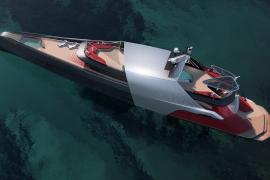
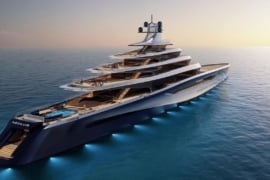
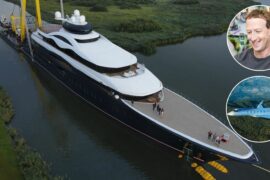
This intensity extended into every corner of Jobs’ life, including the design of his personal spaces. Perhaps nowhere is this clearer than in the superyacht Venus, a 78-meter minimalist vessel designed by Philippe Starck.

Commissioned before his death and completed shortly after, Venus became a physical manifestation of Jobs’ philosophy. It was elegant, spare, and obsessively quiet. Every element was intentional. Soundproofing, layout, materials, and even the blinds were engineered to operate in complete silence. There were no mechanical hums, no electronic whirs. It was, in every sense, a sanctuary designed for deep thought.

One of the most striking features of Venus was its layout. Jobs had the yacht configured so that the teenage children’s cabins were positioned at the front of the vessel, while his own personal cabin and workspace were placed at the back. Between them lay distance, structure, and a communication system.

This wasn’t accidental. It was his way of maintaining uninterrupted focus. He wanted to be able to work on the next Apple prototype with full concentration, even while sailing through the Mediterranean. The physical separation between him and the rest of the family created a buffer zone, allowing him to make calls to Cupertino, sketch concepts, or simply reflect in silence without the risk of distraction.

Jobs’ obsession with silence wasn’t confined to the yacht. At his home in Palo Alto, everything was arranged to preserve calm. Starck recalled how his home was preternaturally quiet. The children were not noisy. The dog did not bark. Even on the day the iPhone 3G launched to global fanfare, the house remained serene. That pursuit of quiet continued aboard Venus, where even the control bridge was fitted with a row of iMacs instead of traditional navigation instruments, creating a digital, noiseless interface aligned with his vision of purity and focus.

Despite the extraordinary attention to detail and the years of development, Jobs never had the chance to enjoy Venus. It was finished after his death, and he never sailed aboard it. The yacht today belongs to his widow, Laurene Powell Jobs. Fittingly, it remains a private sanctuary, with no interior images ever released. The vessel has become something of a floating legend, a monument to a man who believed that great ideas often come in moments of silence.

At present, Venus continues to cut a silent figure on the waters of the Mediterranean, as confirmed by MarineTraffic. Recently, it was spotted cruising off the coast of Majorca, maintaining the quiet legacy of the man who built it not as a luxury toy, but as a space where he could keep building the future, even at sea.