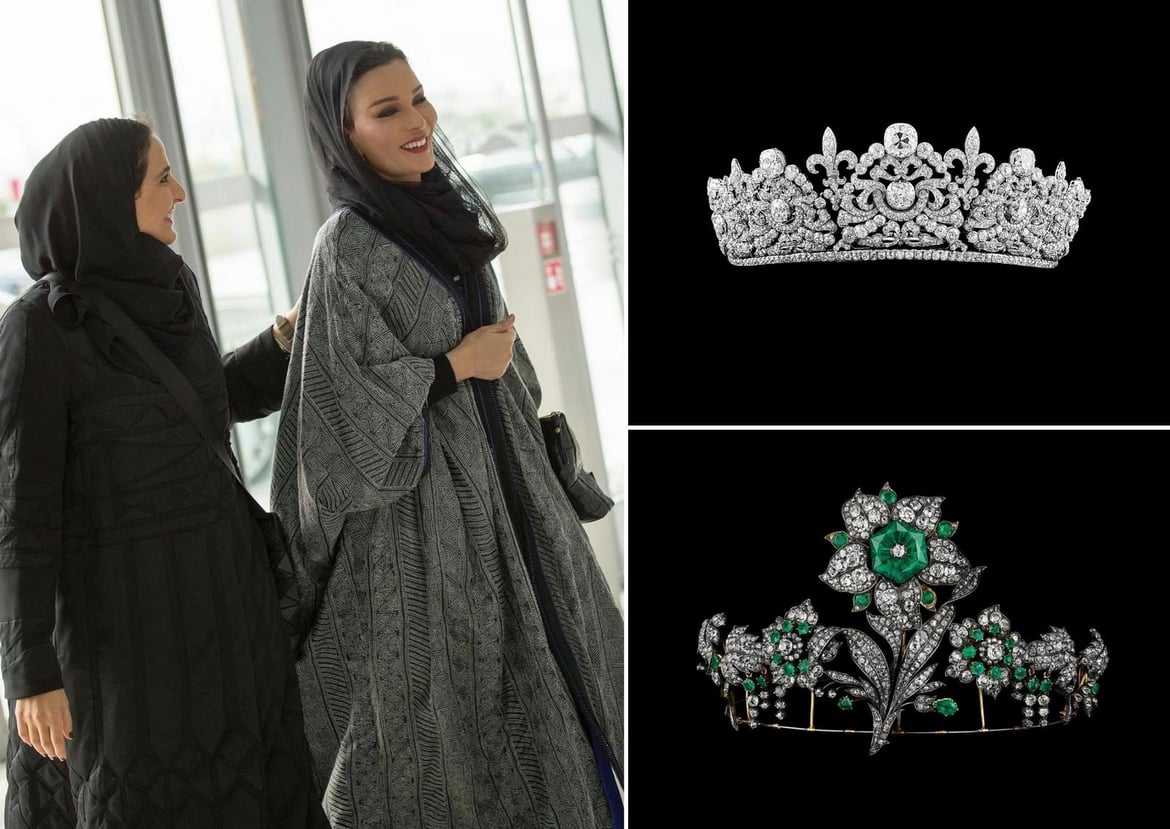
The Qatari royal family is among the richest families on the planet, but unlike many billionaire business dynasties, the Al Thanis’ wealth is steeped in culture, art, and some of the most fascinating things money can buy. Qatar’s sovereign wealth fund, the Qatar Investment Authority, was founded by the state in 2005 to strengthen and diversify the country’s economy and is now worth around $557 billion. Within that broader ecosystem sits one of the family’s most remarkable achievements, the Al Thani Collection, a trove of art, objects, and jewels whose sheer artistry, history, and exquisiteness deserve to be discussed on its own terms.

The collection now spans nearly 6,000 pieces, from art and collectibles to royal and aristocratic jewelry, with the jewels alone valued at over $1 billion. Yet in essence, the Al Thani Collection is much more than money. The family has bought and reassembled some of the greatest creations of several royal lineages across the world, spanning centuries, dynasties, and almost every important type of royal and aristocratic jewelry. Credit for this exceptional jewelry collection, truly one of a kind, goes to Sheikh Hamad bin Abdullah Al Thani, a Qatari prince, art collector, and cousin of the Emir. In 2009, at the age of 27, he visited the exhibition “Maharaja: The Splendour of India’s Royal Courts” at the Victoria & Albert Museum in London.

The prince, who had never visited India, left that show determined to build a collection that could do justice to the brilliance he had just seen. Within a few years, he began acquiring what Spanish magazine Mujerhoy would later highlight as some of the most breathtaking jewels in existence. One of them was what the publication described as the largest faceted blue diamond in the world. That stone sits alongside an entire constellation of princely Indian jewels, such as a platinum and diamond turban ornament set with a 61.5-carat cognac-coloured diamond known as the Eye of the Tiger.

The journey continued with legendary Golconda stones like the Idol’s Eye, a significant 70.21-carat light blue diamond with a rich, documented history that seems to hold light in its depths. Other technically dazzling diamonds, such as the Étoile de Golconde and the briolette-cut Briolette des Indes, add to the sense that this is less a collection and more a private galaxy of historic stones. The Al Thanis did not stop at Indian and Mughal finery, but moved on to acquire European royal jewels such as the famous Arcot II diamond, once belonging to Queen Charlotte and sold by Christie’s in June 2019 for approximately $3.4 million. They also possess the spectacular pearl necklace of Queen Josephine of Sweden, the iconic ruby and diamond bouquet brooch of Empress Josephine, along with her sapphire and diamond brooch, and the diamond bow brooch and girandole earrings belonging to Princess Marina of Greece, wife of Prince George, Duke of Kent.

The collection is mind-boggling, with historic creations and re-creations from major jewelry houses such as Cartier, and it continues to grow as the Al Thani family, now among the most significant collectors in the art world, reportedly dedicates an annual budget of around $1 billion to acquiring new pieces. In 2019, around ten percent of the jewel holdings were sold in the “Maharajas & Mughal Magnificence” auction at Christie’s in New York, raising roughly $110 million, not as a fire sale but as a strategic edit that allowed the collection to be refined and helped fund its next chapter.

As its size and splendor increased, the collection of several thousand jewels found a permanent home in a dedicated museum space that opened in 2021 inside the Hôtel de la Marine on Place de la Concorde in Paris, a historic building that once housed the French Crown Jewels. So grand and extensive is the display that it is managed in partnership with the Centre des monuments nationaux, a French government heritage body, under a 20-year agreement with the Al Thani Collection Foundation. Here, exhibitions allow visitors to journey through time and eras, discovering in a single circuit everything from Indian sarpechs and Golconda diamonds to jewels worn by Empress Joséphine, Catherine the Great, Princess Marina, and other European royals.

At the helm of Qatar’s broader cultural ambitions is Sheikha Al Mayassa bint Hamad bin Khalifa Al Thani, sister of the current Emir and president of Qatar Museums, which manages around ten major art institutions in the country. Rightly dubbed the most powerful woman in the art world, she is the public face of a strategy that has helped bring together artworks and individual gems that rank among the largest and most spectacular in the world.