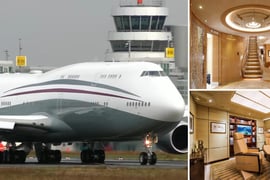
The VVIP Boeing 747-8i donated by Qatar to the United States and now being converted into an interim Air Force One has entered the flight-testing phase, marking a critical step in its transformation from a luxury state transport into a presidential airlifter. After months of modification work in Texas, the aircraft has returned to the air for a series of evaluation flights to validate its systems, integration, and overall readiness ahead of an expected delivery timeline in the summer of 2026.

Several days back, the jet departed from its current base at the L3Harris Technologies facility at Greenville Municipal Airport – Majors Field and carried out a looping test flight over Tulsa, Amarillo, Abilene, and Waco before returning to the same airfield. A plane spotter named TT-33 operator was able to capture the aircraft.

These first test flights are not about dramatic maneuvers or headline-grabbing performance. They are about whether the airplane still behaves like a coherent machine after extensive modifications. Early sorties typically probe the fundamentals such as flight controls, pressurization, electrical stability, autopilot behavior, and the integrity of navigation and communications systems. Even something as routine as switching between ground power, auxiliary power, and engine generators is scrutinized, because a momentary disruption in power could cascade into a loss of critical onboard systems. For an aircraft expected to carry national leadership, that margin for error simply does not exist.

A flying palace becomes a systems testbed
If additional communications hardware, antennas, and secure workspaces have been integrated, the testing becomes even more exacting. Engineers will be watching for electromagnetic interference, checking whether radios compete for bandwidth, and verifying that satellite communications behave reliably under load. These are the invisible details that determine whether an aircraft is merely flyable or genuinely mission-ready.

Weight and balance also come into focus at this stage. A jet originally configured for luxury travel carries its mass very differently from one expected to host secure communications suites and specialized equipment. Even modest changes can influence drag, cooling, and electrical demand. The result is an aircraft that must be re-understood in subtle but important ways before it can be cleared for operational use.

The visual changes, for now, are understated. The jet’s original maroon, white, and gray Qatari livery has been stripped away and replaced by a clean white base coat that signals an aircraft in transition. This is standard practice during modification phases, allowing engineers to complete structural and systems work before final paint is applied. In time, it is expected to receive the new livery featuring a white upper fuselage, a dark blue underside, and red and gold striping, along with national insignia and other markings. Even this aesthetic shift carries technical implications, as darker paint surfaces can influence heat absorption and affect component certification and system performance.

Limits of a rapid conversion
What remains less visible is just as important. While most of the aircraft’s luxurious interior is being retained, current imagery suggests only modest external additions such as new aerials and what appear to be UHF satellite communication antennas. There is no clear indication yet of a fully integrated defensive suite comparable to that carried by the existing presidential fleet. A purpose-built aircraft in this role is expected to combine hardened communications, protection against electronic intrusion, and layered defenses against missile threats. Due to the hurried conversion process, the aircraft will also not feature a mid-air refueling system – a feature that gave Air Force One unlimited range.

Given the compressed timeline, the most realistic path involves modular countermeasures rather than deeply embedded systems. Directed infrared countermeasures, designed to disrupt heat-seeking missiles, represent a credible baseline and are already used on high-risk civilian and government aircraft. They offer protection but not the comprehensive survivability of a platform engineered from the outset for that mission.

A deeper constraint lies in areas that cannot be easily retrofitted. Electromagnetic pulse hardening, for instance, is integral to aircraft designed as airborne command centers. It is not something that can be added quickly to a 13-year-old airframe. That distinction quietly defines the role this aircraft is likely to play. It can function as a capable transport with enhanced communications, but it may be best suited to lower-risk routes rather than environments that demand maximum resilience.
The aircraft has been flying test sorties under the call sign “Vader 01,” an unusual and memorable identifier. The name carries an obvious cultural reference to Darth Vader while also translating to “father” in Dutch and Afrikaans. In operational terms, it is simply a temporary test call sign, underscoring that the aircraft has not yet entered formal presidential service. Only when the president is on board would it assume the Air Force One designation.
For now, that transition remains a work in progress. The official position is straightforward. Flight testing is underway, and delivery is expected by summer 2026. Behind that timeline sits a far more intricate effort, one that is steadily reshaping a former flying palace into an aircraft capable of meeting the unique demands of presidential airlift, even if only for a limited window of service.