Bill Gates’ vision for transforming maritime transportation extends far beyond luxury vessels. While his hydrogen-powered superyacht captured headlines as a symbol of clean marine technology, his latest venture represents a fundamental shift toward revolutionizing global shipping through nuclear propulsion. The Microsoft co-founder is now channeling his environmental ambitions into developing nuclear-powered cargo ships that could eliminate massive carbon emissions from one of the world’s most polluting industries.

This transformation begins with TerraPower, the nuclear innovation company Gates founded in 2006 with over $1 billion of his personal capital committed over nearly two decades. As founder and chairman, Gates has steadily built TerraPower into a leader in advanced reactor technology, recently securing $650 million in funding from investors including HD Hyundai and NVIDIA’s venture capital arm, as reported by Interesting Engineering. This latest investment brings TerraPower’s total private financing to over $1.4 billion, funds specifically earmarked for advancing its revolutionary Natrium reactor project.

The partnership between TerraPower and HD Hyundai represents a convergence of nuclear innovation and maritime engineering expertise. HD Hyundai, the world’s largest shipbuilder, brings unmatched manufacturing capabilities and a deep understanding of marine vessel construction. On August 22, 2025, this collaboration deepened when HD Hyundai Executive Vice Chair Chung Ki-sun met with Gates and TerraPower leadership in Seoul to expand cooperation on nuclear supply chains.

These discussions covered critical aspects of heavy-component supply for TerraPower’s Natrium reactors and joint development of molten-salt reactor concepts specifically designed for marine applications. Korean coverage emphasized how this meeting tightened small modular reactor ties, positioning HD Hyundai as both a core manufacturing partner and an early mover in nuclear-propelled commercial vessels.

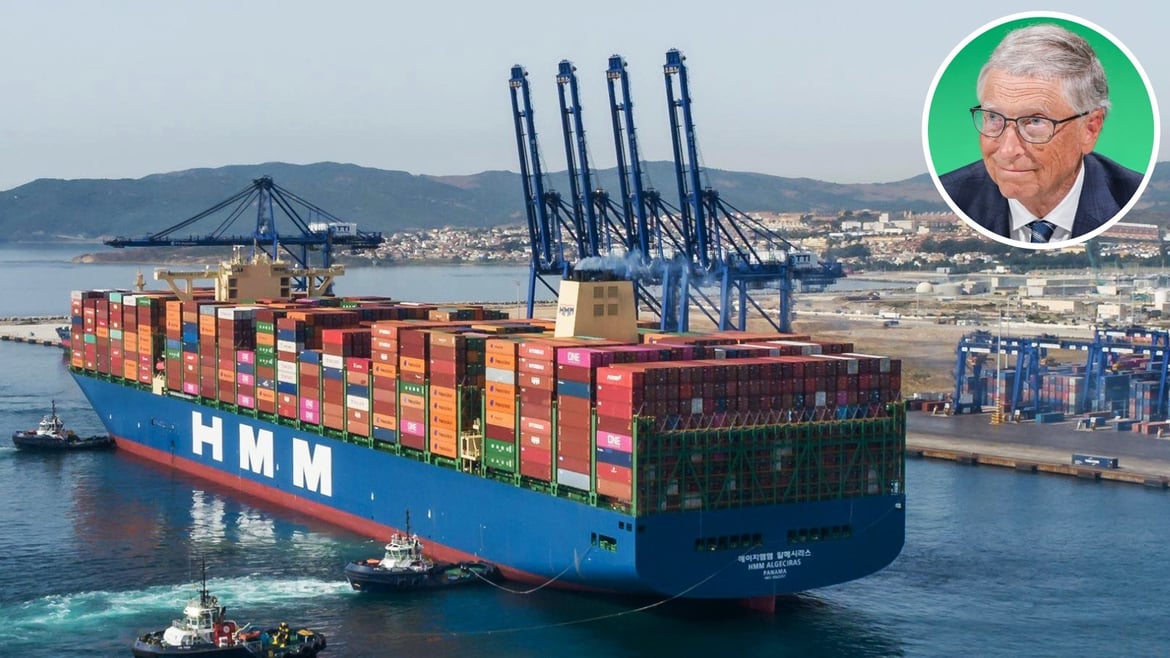
The environmental impact potential is staggering. Ultra-large container ships carrying over 20,000 TEU typically burn approximately 250 tons of fuel daily at service speed. Using the International Maritime Organization’s carbon factor of 3.114 tons of CO₂ per ton of heavy fuel oil, these vessels emit roughly 779 tons of CO₂ daily on a tank-to-wake basis. Nuclear propulsion would eliminate these emissions entirely, saving approximately 10 tons of fuel burned every hour and preventing 33 tons of CO₂ emissions hourly.

This represents more than incremental improvement — it’s a complete paradigm shift for an industry responsible for nearly 3% of global greenhouse gas emissions. While traditional decarbonization efforts in shipping have focused on alternative fuels like ammonia or hydrogen, nuclear propulsion offers unlimited range and consistent power output regardless of weather conditions or refueling infrastructure.

Breakthrough Superyacht: A testing ground
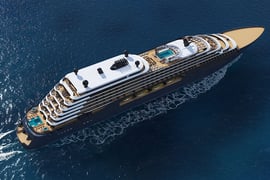
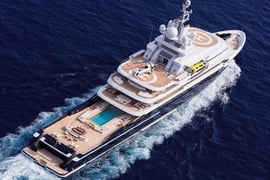
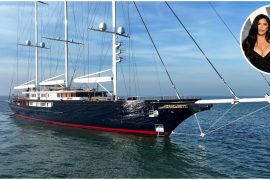
Gates’ hydrogen-powered superyacht Breakthrough served as an important proof-of-concept for alternative marine propulsion. Although notably, Gates has never actually set foot aboard the vessel and is currently selling it. The development of this luxury yacht demonstrated the feasibility of clean marine technologies, but more importantly, it established credibility for pursuing larger-scale maritime decarbonization projects.

The progression from luxury yacht to commercial shipping represents the scaling-up of Gates’ maritime vision to achieve global impact. While a superyacht serves as a high-profile demonstration of alternative fuel potential, nuclear-powered cargo ships and tankers could transform international trade by eliminating emissions from the vessels that carry 90% of global goods.

HD Hyundai’s expertise in constructing massive commercial vessels, combined with TerraPower’s advanced reactor technology, creates a powerful alliance capable of bringing nuclear maritime propulsion from concept to reality. Their collaboration on molten-salt reactor designs specifically optimized for marine environments suggests a serious commitment to overcoming the unique challenges of operating nuclear systems at sea.

This partnership positions both companies at the forefront of what could become the most significant transformation in maritime transportation since the transition from sail to steam power, with Gates once again demonstrating his ability to identify and invest in technologies capable of reshaping entire industries.