Owning one of the world’s most technologically advanced superyachts comes with a price far beyond its purchase cost. Canadian billionaire and former NHL player Patrick Dovigi, who acquired the hydrogen-powered superyacht Breakthrough last year, has now reportedly invested around $5 million in what appears to have been the vessel’s first major maintenance program since delivery. For a yacht valued at approximately $650 million, the expenditure is less about fixing problems than ensuring that every system aboard continues to perform exactly as intended.

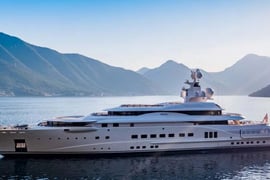
The 390-foot (118.8-meter) Feadship flagship, long associated with Microsoft co-founder Bill Gates before changing hands, spent roughly a month in La Ciotat, France, one of Europe’s leading superyacht maintenance hubs. AIS tracking data shows the yacht arrived on June 16 and departed on July 16, a timeline that aligns closely with the vessel’s first annual class survey following its May 2025 delivery. While the exact shipyard involved has not been disclosed, the extended stay strongly suggests a comprehensive maintenance and inspection program rather than a cosmetic stopover.

A month-long checkup for one of the world’s most advanced yachts
Unlike conventional luxury yachts, Breakthrough combines cutting-edge engineering with complex environmental technology, making its annual maintenance considerably more involved than routine servicing. The first-year program would likely have focused on every major mechanical, electrical and safety system aboard the vessel.

Engineers would have carried out hour-based servicing on the yacht’s five MTU generator sets, inspecting everything from oil, filters and turbochargers to vibration readings and cooling systems. The twin 3,200-kilowatt ABB azimuth propulsion units would also have undergone detailed inspections covering bearings, shaft seals, steering systems, lubricants and power electronics. The vessel’s DC electrical grid, battery systems, switchboards, converters and sophisticated power-management software would have been tested to ensure seamless operation.

Attention would also have turned to the yacht’s many luxury features. Breakthrough incorporates 14 extending balconies, seven opening platforms and numerous shell doors, each relying on intricate hydraulic systems, sensors and safety mechanisms that are obvious candidates for first-year warranty inspections. Other likely work included servicing the infinity pool, spa facilities, waste-heat recovery system, Smart AC climate controls and the countless mechanical systems hidden beneath the yacht’s elegant exterior. Cosmetic touch-ups, teak deck refinishing, glazing inspections, drainage improvements and vibration corrections are also common during a post-delivery maintenance cycle.

Maintaining a floating hydrogen laboratory
What truly sets Breakthrough apart is its pioneering propulsion system. Built by Dutch shipyard Feadship and designed by British studio RWD, it is widely recognized as the first large superyacht centered around liquid-hydrogen fuel-cell technology.

At the heart of the system sits a 92-cubic-meter vacuum-insulated Type C liquid-hydrogen tank supplied by MAN Cryo. Stored at an astonishing minus 253 degrees Celsius, the tank can hold roughly four tonnes of liquid hydrogen. Sixteen PowerCell fuel-cell modules generate approximately 3 to 3.2 megawatts of electricity, while sophisticated software continuously monitors tank conditions and energy production.

The annual inspection would likely have focused on verifying the integrity of the entire hydrogen installation. Engineers would have examined tank supports, insulation performance, pressure and boil-off data, hydrogen detectors, emergency shutdown systems, bunkering equipment, vaporizers and safety valves. Fuel-cell modules would also have been checked for operating efficiency, stack performance, coolant condition and software updates. Industry rules generally call for external inspection rather than opening the cryogenic hydrogen tank itself, a procedure reserved only for exceptional circumstances.

A superyacht designed without compromise
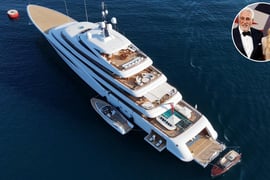
Beyond its engineering, Breakthrough delivers every luxury expected of a flagship superyacht. The vessel accommodates 30 guests across 15 cabins, supported by a crew of up to 43. Instead of a traditional owner’s suite, the yacht features an extraordinary four-level private townhouse complete with bedrooms, dressing rooms, offices with fireplaces, a private library, gym, elevator and secluded dining areas overlooking the sea.

The remaining guest spaces are equally impressive. A beach club-inspired infinity pool, multiple hot tubs, a cinema, several libraries, expansive lounges, a basketball court, helipad and even a private hospital reflect the extraordinary scale of the project. The interiors combine marble, textured fabrics, leather, rattan and limed oak to create a refined coastal aesthetic, while hidden balconies slide out electronically to blur the boundary between indoor and outdoor living.

Breakthrough also recycles waste heat generated by its hydrogen system to warm the pool, steam room, heated flooring and towel rails, demonstrating that sustainability and luxury need not exist at opposite ends of the spectrum.

For most yacht owners, a $5 million maintenance bill would be unimaginable. For the owner of one of the world’s most ambitious engineering projects afloat, however, it is simply the cost of preserving a vessel that continues to redefine what a modern superyacht can be.