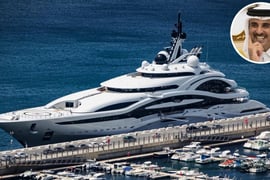
The Burj Al Arab is one of the world’s most recognizable hotels, instantly identifiable by its sail-shaped silhouette rising above Dubai’s coastline. But what many people don’t realize is that the architectural inspiration eventually came full circle. After commissioning the hotel, Sheikh Mohammed bin Rashid Al Maktoum, the Emir of Dubai, wanted a yacht that captured the same dramatic atmosphere on the water. In a rare twist of design history, a hotel inspired by a traditional Arabian dhow ultimately became the inspiration for a superyacht.

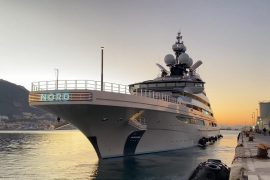
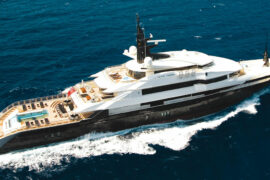
That vision became Dubai, the 532-foot (162-meter) royal superyacht now valued at around $500 million. Former Platinum Yachts managing director Kostis Antonopoulos, who oversaw the project’s completion, told Boat International in an interview that “the brief was simple: the owner wanted a floating Burj Al Arab—and he got it.”

He also described the finished interior as “an attack on the senses.” Antonopoulos additionally recalled that the project employed nearly 800 workers, many of whom had never built a superyacht before, prompting him to fly staff to the Monaco Yacht Show so they could study the craftsmanship expected aboard the world’s finest yachts.

A hotel’s uber-luxurious interiors recreated at sea
Rather than copying the Burj Al Arab’s famous sail-shaped exterior, the yacht borrowed its interior philosophy. Andrew Winch’s elegant exterior remained relatively restrained, but stepping inside is like entering a maritime version of Dubai’s iconic hotel. The centerpiece is a vast four-deck atrium stretching nearly the yacht’s entire 22-meter beam, crowned by a skylight and anchored by a spiraling stainless-steel staircase with illuminated glass steps that change color.

The similarities continue throughout the yacht. Just as the Burj Al Arab dazzles guests with soaring spaces, gold accents and vibrant colors, Dubai surrounds visitors with gold-leaf finishes, marble, onyx, lapis lazuli, malachite, richly patterned carpets and illuminated glass. Sweeping mosaic floors transform ordinary walkways into visual spectacles, while a formal majlis-style salon, grand reception rooms and a dining room capable of hosting around 80 guests reinforce the atmosphere of an Arabian palace.

The owner’s private residence mirrors the exclusivity of the Burj Al Arab’s celebrated Royal Suite. Occupying the two uppermost decks, the split-level apartment has its own elevator and direct access to the yacht’s helipad, allowing complete privacy.

Water, color, and luxury define every space
One of the clearest links to the Burj Al Arab is the yacht’s remarkable swimming pool. Holding roughly 110 tons of water, it features handmade mosaics depicting marine life from the Persian Gulf, with embedded optical fibers creating shimmering underwater effects. Water then cascades down a two-deck waterfall, turning a simple pool into an elaborate centerpiece that echoes the hotel’s famous fountains and aquariums.

The yacht’s amenities are equally lavish. Guests have access to a cinema, nightclub, spa, beauty salon, gym, multiple Jacuzzis, limousine tenders, a submarine garage and expansive outdoor entertainment areas. Even the onboard medical clinic was designed with an independent ventilation system to reduce infection risks, an unusually advanced feature when the yacht entered service in 2006.

From abandoned hull to global icon
The road to completion was anything but straightforward. Originally commissioned in the mid-1990s by Prince Jefri Bolkiah of Brunei as Project Panhandle, construction stalled after only the steel hull and part of the aluminum superstructure had been completed. Dubai later acquired the unfinished vessel, which passed through Turkey before Platinum Yachts completed it in the UAE using hundreds of local craftsmen.

The project became more than a royal indulgence. It demonstrated that Dubai could finish one of the world’s largest and most technically demanding private yachts despite having limited experience in superyacht construction. At launch in 2006, Dubai was the world’s largest private yacht and remains among the longest afloat today.

Maintaining such an extraordinary vessel is almost as remarkable as building it. Industry estimates place her annual upkeep at around $50 million, a figure that reflects the enormous crew, sophisticated engineering systems and meticulous care required to preserve one of the most extravagant floating residences ever created. More than a superyacht, Dubai stands as the nautical continuation of the same bold design philosophy that transformed the Burj Al Arab into a global symbol of luxury.