Ferrari has taken an unusual route with its latest addition to the 296 line, choosing to remove technology rather than add more of it. The new 296 Challenge Stradale abandons the hybrid system found in the 296 GTB and 296 Speciale, relying entirely on a twin-turbocharged V6 to deliver its performance. The result is a lighter, more focused supercar that borrows heavily from Ferrari’s racing program while retaining the essentials needed for road use. It is an interesting move at a time when electrification is increasingly becoming the default route to greater performance.

The Challenge Stradale also brings back a name associated with some of Ferrari’s most engaging road cars. Its predecessor, the 360 Challenge Stradale, arrived in 2003 with a similar ambition to bring the character of a racing machine to a road-legal Ferrari. More than two decades later, the formula has evolved considerably, but the underlying idea remains familiar. Rather than chasing the biggest power figure in the lineup, Ferrari has concentrated on reducing weight, improving aerodynamic performance, and making the driving experience considerably more involving.

A non-hybrid V6 with a serious weight advantage
At the heart of the 296 Challenge Stradale is a 3.0-liter, 120-degree V6 engine equipped with two turbochargers. It produces 661 horsepower and 546 lb-ft of torque, with maximum power arriving at 8,000 rpm. An eight-speed dual-clutch transmission sends everything to the rear wheels, doing away with the electric motor and battery that assist the regular 296 models. Ferrari has revised the engine’s boost pressure and cam timing to improve torque delivery, helping compensate for the absence of electric assistance.

Removing the hybrid hardware saves 309 pounds compared with the 296 GTB and 176 pounds compared with the 296 Speciale. The car has a claimed dry weight of approximately 2,932 pounds, an impressive figure for a modern road-going supercar. Ferrari also had to rework several supporting systems, including the air-conditioning compressor and electrical architecture, to accommodate the new configuration. Acceleration remains formidable, with 0 to 62 mph taking 2.8 seconds and 0 to 124 mph arriving in 7.9 seconds. Its reported Fiorano lap time of 1 minute and 18.5 seconds is particularly revealing, putting it half a second ahead of the more powerful 296 Speciale.
Racing aerodynamics and a sharper chassis
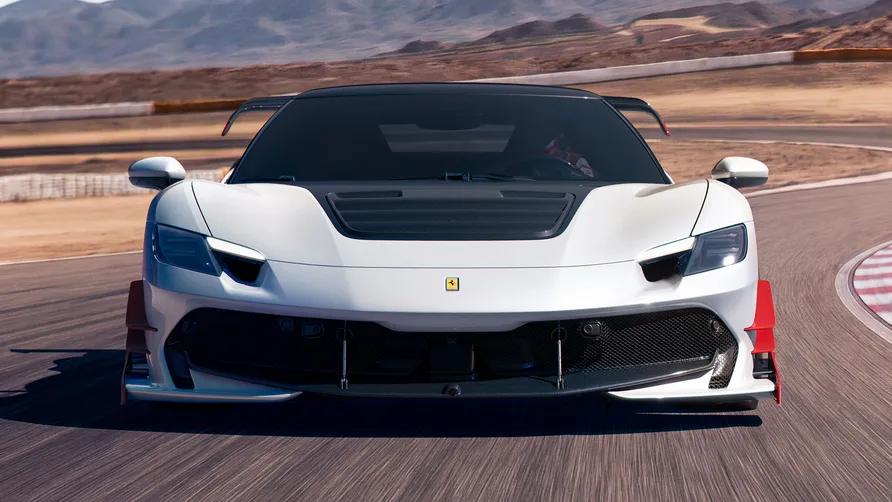
The most obvious indication of the car’s intentions is its aerodynamic package. A prominent front splitter, additional canards, revised bonnet openings, an enclosed underbody, and a substantial fixed rear wing give the Stradale a considerably more aggressive appearance than the standard 296. Ferrari claims that the package generates 1,360 pounds of downforce at 155 mph, representing a 72% improvement over the 296 GTB. The rear wing alone contributes approximately 595 pounds, while the remaining aerodynamic components work together to keep the car planted at speed.


The mechanical changes are just as extensive. Ferrari has stiffened the suspension springs, recalibrated its adaptive dampers, and widened the front and rear tracks to improve stability through corners. Carbon-ceramic brakes provide stopping power, while buyers can choose between Pirelli P Zero R and the more track-oriented P Zero Trofeo RS tires. The electronics have also received attention, with updated ABS Evo and predictive slip-control systems helping drivers extract more performance without making the car unnecessarily difficult to manage. Despite its competition-inspired setup, Ferrari has retained road-friendly features, including two separate bumpy-road suspension settings.

A stripped-back cabin and a different kind of Ferrari
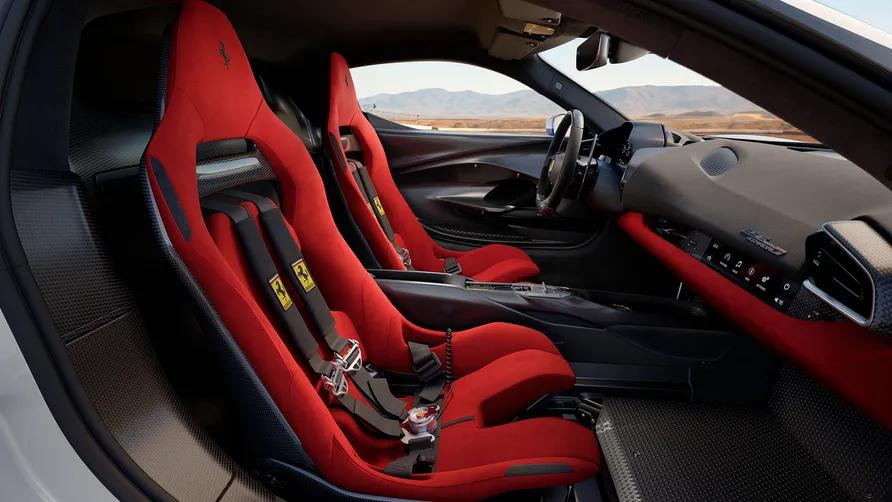
Inside, the Challenge Stradale continues its weight-saving approach with extensive carbon-fiber components, lightweight tubular racing seats, and simplified door panels. Conventional carpeting and sound insulation have been reduced or removed, allowing more of the V6’s mechanical character to reach the cabin. Buyers can also choose an optional exposed-chassis configuration that takes the stripped-back philosophy further. Ferrari has not abandoned everyday equipment entirely, however, with modern driver assistance systems and convenience features remaining available.
Interestingly, the Challenge Stradale is not intended to be a limited-production collectible. Ferrari is positioning it as a regular-production model, with an anticipated price of around $330,000 based on the reported British pricing. That puts it below the more expensive 296 Speciale while offering a distinctly different interpretation of performance. Its philosophy is closer to the Porsche 911 GT3 RS than a conventional high-powered grand tourer, prioritizing precision, feedback, and repeated track use. In an era when more power often means more electrical assistance, the 296 Challenge Stradale makes a compelling argument for the appeal of less weight and a more direct connection between driver and machine.