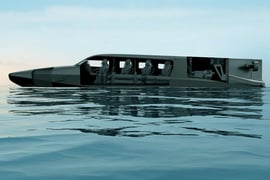
More than two decades after it first slipped into existence like a prototype from a future that had not yet arrived, a powerboat that looks uncannily like the Tesla Cybertruck is preparing for a second debut. From May 27 to 31, the long-forgotten Code X will return to public view at the Venice International Boat Show, displayed in Padiglione 1, a setting that feels almost poetic for a machine that never quite belonged to its own time.

Code X was the creation of Fabio Buzzi, a man whose career was defined by speed, experimentation, and a refusal to respect the limits that defined conventional naval architecture. Built roughly 25 years ago, the catamaran emerged from an unlikely collaboration with Swiss entrepreneur Peter Grauer, who approached Buzzi with a concept that bordered on obsession, as pointed out by Barcheamotore. He wanted a boat that could harness renewable energy, integrate solar power, and even explore cleaner fuels at a time when such ideas were barely discussed outside laboratories.

Buzzi did not simply refine the idea. He rewrote it entirely. The result was a wide, aggressively styled catamaran with proportions that defied the accepted logic of performance boats. Instead of slender hulls designed purely for speed, Code X featured broad, voluminous forms that allowed for interior comfort while still delivering remarkable hydrodynamic efficiency. A full deck of solar panels fed lithium-ion batteries, supporting onboard systems and hinting at hybrid propulsion long before the term became fashionable in the marine world.

The engineering ran deeper than the surface. Powered originally by twin V10 engines derived from American muscle, the boat incorporated a unique triple-flap system that manipulated airflow beneath the hull to increase lift and stability. It was capable of exceeding 60 knots, yet it could plane at speeds that would typically leave similar vessels struggling. Even today, those figures read less like nostalgia and more like a specification sheet for a modern experimental craft.


Visually, the comparison to the Cybertruck is difficult to ignore, even if it arrives from a different era. Both share a sharp-edged, almost confrontational design language that prioritizes function over familiarity, creating forms that feel engineered rather than styled. Where the Cybertruck translates that philosophy to land, Code X executed it on water decades earlier, with the same polarizing effect.

And yet, despite delivering on its promise, Code X disappeared. It spent years in storage, unused and largely forgotten, a victim not of failure but of timing. Only recently has it been revived, restored, and returned to the water, where it continues to turn heads with the same intensity it once provoked.
Its appearance in Venice is more than a showcase. It is a reminder that innovation does not always align with its moment, and that some machines are built not for the present, but for a future that takes its time catching up.