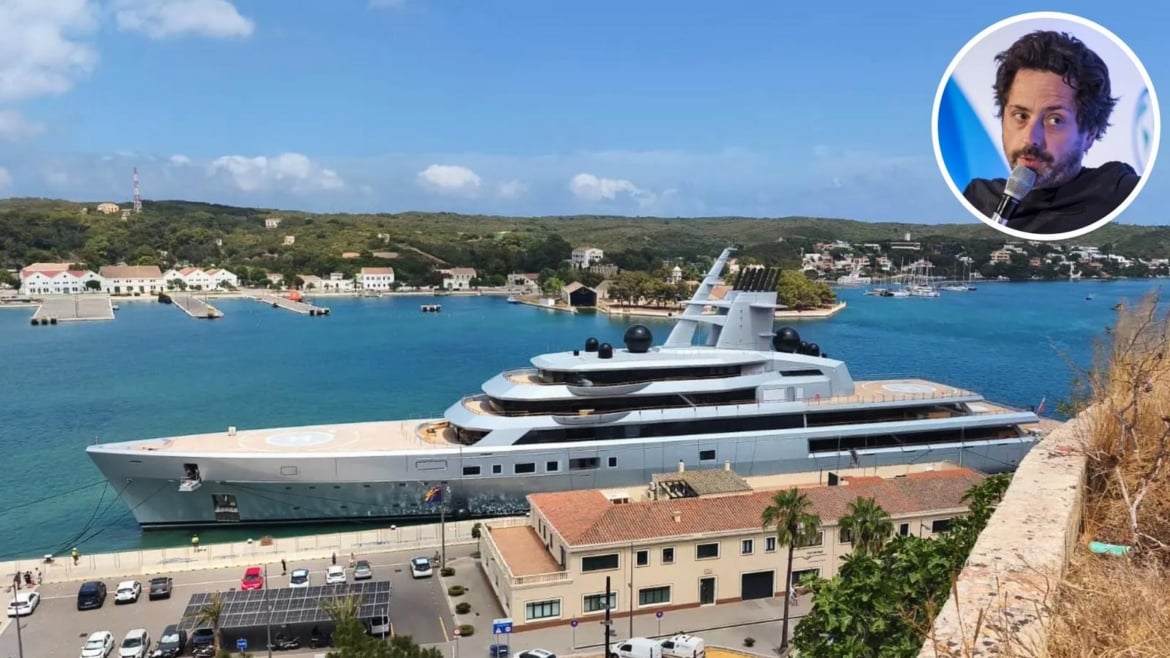
Sergey Brin’s 466-foot superyacht Dragonfly is the kind of vessel that can make even a major Mediterranean harbor look undersized. The $450 million superyacht recently arrived in the Spanish port city of Maó, Menorca, and instead of slipping into the island’s principal superyacht marina, it had to use the city’s cruise-ship berth at Moll de Ponent.

Dragonfly’s arrival in Maó was never going to be an ordinary superyacht call. The Lürssen-built behemoth is so outsized that the marina reserved for the world’s most extravagant yachts simply could not take it. Instead, one of the world’s largest private yachts had to be accommodated at a 258-meter cruise berth on the western quay of a Spanish Navy naval station, turning an already extraordinary yacht into an even more unusual sight in the harbor.

A superyacht that needed a naval quay
The Moll de Ponent is the western quay of Spain’s Estación Naval de Mahón on Isla de Pinto, rather than a conventional civilian marina. The Port Authority of the Balearic Islands has been able to use parts of the naval station under an agreement with Spain’s Ministry of Defence dating to 2000. The 258-meter berth itself was created through a 2003 project to adapt the naval quay for cruise ships, giving Dragonfly the unusual combination of length and access it needed.

Dragonfly could have remained at anchor offshore, but docking offered obvious practical advantages. A vessel of this scale needs room for mooring lines, security, vehicles, provisions, waste collection and technical crews, while guests can move directly between the yacht and shore without relying on tenders. The open commercial berth is also more practical than a tightly packed marina for a yacht equipped with two helicopter facilities, although there is no confirmation that helicopters operated from Dragonfly during its Maó visit.

The yacht quickly became a spectacle in the harbor, with people gathering along the waterfront to photograph it. Its scale was particularly striking from the water. When the expedition cruise ship World Traveller entered Maó days later, passengers were reportedly encouraged to watch the harbor approach, with one cruise correspondent initially mistaking Dragonfly for a naval ship and remarking that it looked roughly comparable in size to the cruise vessel.

Inside Sergey Brin’s floating headquarters
Delivered by German shipbuilder Lürssen in 2024, Dragonfly was originally commissioned by Russian billionaire Leonid Mikhelson. International sanctions prevented its delivery, and the yacht eventually ended up in American hands with Brin as its owner. It was reportedly presented as the largest luxury yacht ever registered in the United States at the time.

For all its military-looking scale, Dragonfly is unmistakably a private luxury retreat. It has 12 cabins, a glass-bottom swimming pool, gym, games room, beauty salon and extensive spaces for recreation. Its diesel-electric hybrid propulsion system is designed for efficient and quiet operation, while an onboard seawater desalination plant gives the yacht its own fresh-water supply. Its electricity consumption is equivalent to that of around 600 homes.

Perhaps the most revealing feature, however, is the yacht’s dedicated business deck. Brin is known for an intense work ethic, and Dragonfly reflects that personality unusually clearly. Rather than treating the superyacht purely as an escape from Silicon Valley, an entire deck is devoted to business, incorporating a large private office alongside a gym, games room and concealed helicopter hangar.

Even away from the office, Dragonfly is expensive to keep moving. Its annual running costs are estimated at between $30 million and $40 million, covering expenses such as crew, insurance, customs and docking. For Brin, whose fortune exceeds $132 billion according to the Menorca report, that is the price of maintaining what is effectively a 142-meter private headquarters that can cross the world’s oceans.