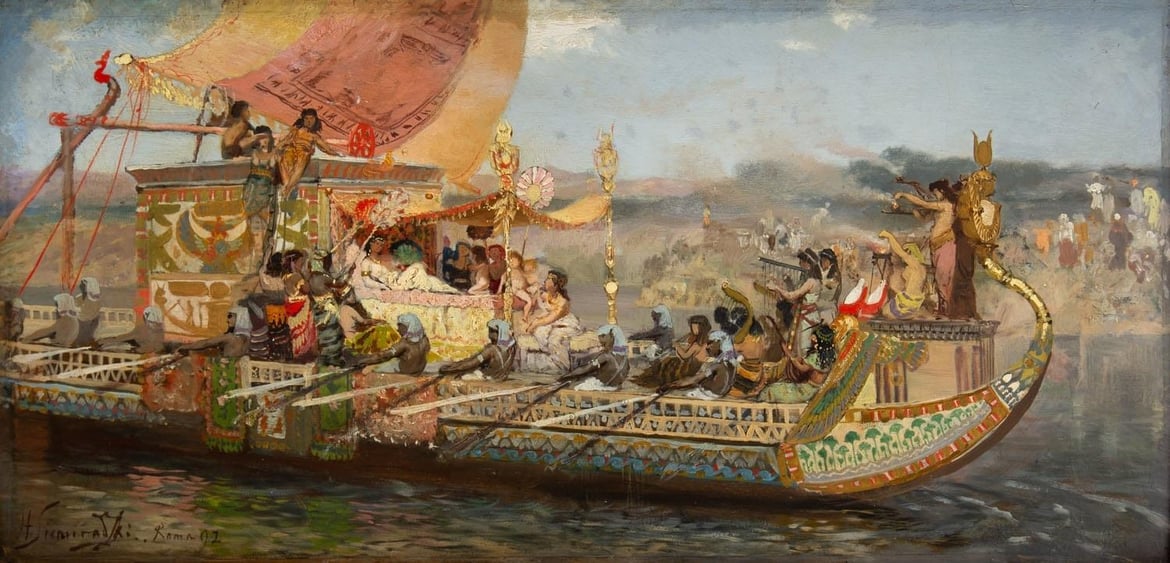
Superyachts have gained momentum in the modern world, especially after 2020. Yes, they have been around for decades, even centuries, but the craze is new. While we fawn over big boats like Dragonfly, Koru, Launchpad and Kismet, archaeologists have discovered something that surpasses these superyachts in terms of history and sheer extraordinariness. A 2,000-year-old wreck of an ancient Egyptian pleasure barge, similar to the one said to have been used by Cleopatra to show Julius Caesar the sights of Egypt, has been uncovered. At 23 meters, or 75 feet, it falls just 1 meter short of the modern definition of a superyacht, but considering it is 2,000 years old, we can give it a little grace.

This incredible Egyptian equivalent of a superyacht was discovered by the Institut Européen d’Archéologie Sous-Marine (IEASM) off the coast of Alexandria, submerged in the port of the island of Antirhodos. This was not just any island. Antirhodos was part of Cleopatra’s palace district, a royal micro-world of colonnades, statues and sanctuaries, including a Temple of Isis that many scholars now describe as the queen’s “last temple.” The barge was found in the tiny royal harbor for this complex, essentially parked in Cleopatra’s own sacred and political backyard.

It appears to be a thalamagos, or houseboat in layman’s terms, and is the first physical example of its kind to be discovered. For centuries, historians have had to rely on ancient texts and mosaics to imagine these cabin boats. Now, for the first time, there is an actual hull on the seabed to match the stories. On closer inspection, it resembles the cabin boats described by the writer Strabo in the first century BC. Greek graffiti cut into the central carling dates the ship to the first half of the first century AD, which places it just after Cleopatra’s death, but still within living memory of her reign in early Roman Egypt.

Archaeologists are careful not to claim this as Cleopatra’s personal barge, yet everything about it, from its date to its mooring spot beside her temple, roots it firmly in her world. Franck Goddio, a visiting professor in maritime archaeology at the University of Oxford, told The Guardian, “It’s extremely exciting because it’s the first time ever that such a boat has been discovered in Egypt … Those boats were mentioned by different ancient authors, like Strabo, and they were also represented in some iconography, for example in the Palestrina mosaic, where you see such a boat of a much smaller size with noblemen hunting hippopotamuses. But [an actual boat] has never been discovered before.”
Not only was the wreck successfully discovered, it had been lying only 7 meters under the water and 1.5 meters under the sediment, almost as if it were waiting to be found. The team has recorded the hull using high-resolution 3D photogrammetry, which will be instrumental in helping others study the boat, now preserved as a “digital artifact.” Research on the wreck is still in its early stages, and per UNESCO guidelines, the vessel itself will remain on the seabed for conservation.

What the vessel looks like:
The 75-foot ship featured a flat-bottomed hull with a hard chine at the bow and a rounded turn at the stern to be able to navigate in very shallow water. The full-beam equivalent of a superyacht perhaps accommodated a central pavilion, a luxuriously decorated cabin, and boasted a breadth of 7 meters, or 23 feet. Instead of MTU engines, it was propelled only by oars and probably required more than 20 rowers.

The luxuriously fitted-out vessels were commonly used by the royal court for excursions and to travel from Alexandria by the canal to public festivals. Ancient writers describe royal cabin boats in Alexandria where officials and revelers drank, listened to flutes and danced. Much later, Plutarch and Shakespeare would turn Cleopatra’s river arrival into the ultimate luxury entrance, with a barge like a “burnished throne” burning on the water, its purple sails perfumed and its silver oars keeping time to music. With the discovery of this wreck, that legendary image finally has a real Egyptian hull beneath it.