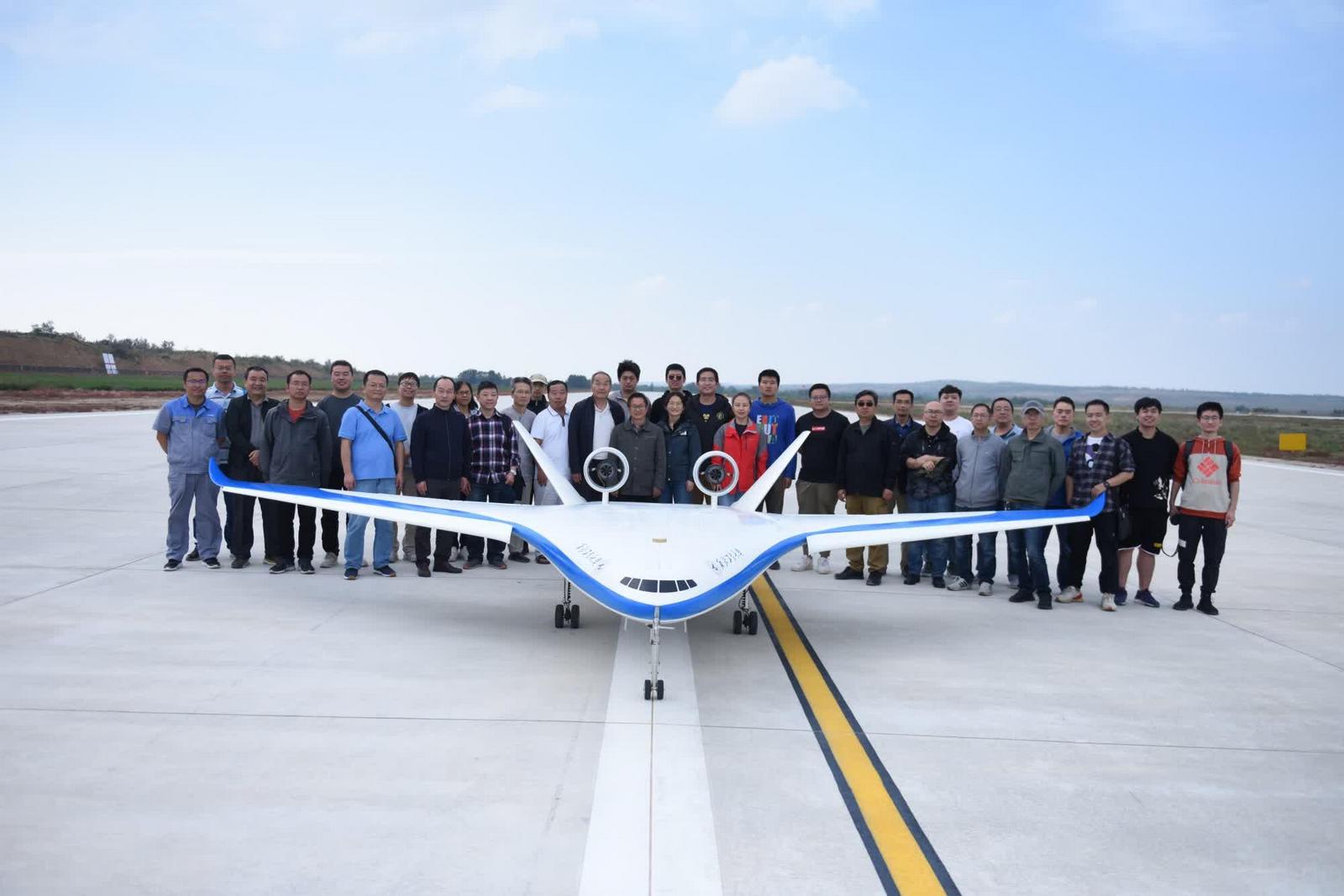
China is exploring an aircraft concept that looks less like a conventional airliner and more like a giant airborne wing. Instead of putting a long cylindrical fuselage between two wings, the design blends the passenger cabin and lifting surfaces into one broad body, potentially creating a radically different way of carrying hundreds of people across long distances. In concept, it’s very similar to another conceptual aircraft named JetZero Z4.

Being developed by the China Aerodynamics Research and Development Centre (CARDC), the concept is intended to represent an aircraft capable of carrying 800 or more passengers, according to a report by the South China Morning Post. Its full-size reference geometry would stretch approximately 85 meters across while measuring only 43 meters in length, giving it an extraordinary width-to-length ratio and making it substantially wider than today’s largest passenger jets.
China is pushing the flying wing into A380 territory and beyond
CARDC is no newcomer to major Chinese aviation programs, having conducted aerodynamic work for aircraft including the C919 passenger jet and Y-20 military transport. What makes this project unusual is the scale. The research reportedly began with a much more commercially familiar concept for around 250 passengers, roughly the capacity of an Airbus A330 or Boeing 767, before being expanded into the 800-seat class.

Researchers describe the configuration as a high-aspect-ratio flying wing, although the closely related terms blended-wing body and hybrid-wing body are also widely used in civil aviation. Whatever the terminology, the principle is the same. The aircraft’s body and wings merge into one enormous lifting surface, allowing parts of the structure that would normally be a conventional fuselage to contribute to lift.

The result could be an aircraft considerably different from the Airbus A380. The A380 typically carries around 555 passengers, while China’s proposed aircraft is aimed at more than 800. Its enormous 85-meter span would also make it roughly 1.6 times as wide as the Northrop Grumman B-2 Spirit, another famous flying-wing aircraft.

Yet the most interesting question may not be how such an aircraft flies, but what happens inside it. A conventional airliner is essentially a long corridor, with passengers arranged along one or two aisles. A flying wing could instead be divided into several broad passenger bays. Airlines could potentially create family sections, business and quiet zones, intimate premium cabins, larger galleys, social areas and lounges, with shorter local aisles serving individual sections.

Airbus’s MAVERIC cabin concept offers a glimpse of how China’s proposed 800-seat flying wing could transform air travel, replacing the traditional tube-shaped interior with wider, lounge-like spaces and digitally enhanced windows. This rendering does not depict the Chinese aircraft.

That could make an 800-seat aircraft feel more like a collection of smaller cabins than one enormous jet. It could also allow suites to be spread across a wider interior rather than squeezed into the narrow geometry of a conventional fuselage. But there is an obvious risk. If airlines use all that additional space simply to maximize seat density, the same aircraft could feel more like a crowded hall than a futuristic luxury cabin.

Windows present another major challenge. Because the cabin would extend far beyond the narrow width of a traditional fuselage, many passengers could sit a long way from the exterior walls. Conventional windows may also be more difficult to integrate into a highly pressurized, non-cylindrical structure. Digital windows, exterior-camera feeds, curved displays and artificial daylight could become alternatives, although a screen showing the horizon is not psychologically identical to looking through a real window, particularly for passengers susceptible to motion sickness.

The configuration could potentially improve noise levels as well. Flying-wing designs often place their engines above the rear portion of the body, allowing the aircraft to shield some engine noise from passengers and communities below. NASA and Boeing explored similar principles with the X-48 blended-wing-body demonstrators. However, CARDC has not disclosed the final engine arrangement of its 800-passenger concept, so a quieter cabin remains a possibility rather than a confirmed feature.

An aircraft this large could also have an unusual advantage at congested airports. An 800-seat departure could move roughly the same number of passengers as two 400-seat flights while using a single runway movement. At slot-constrained megahubs, that could be valuable. The trade-off would be frequency, since two smaller aircraft can depart at different times. A cancellation involving one giant aircraft could also strand hundreds more passengers at once. And then comes the turnaround. Moving 800 passengers means handling enormous quantities of baggage, catering, cargo, wheelchairs and connecting travelers while cleaning and refueling the aircraft on a tight schedule. Its success may ultimately depend as much on how quickly an airport can empty and refill it as on how efficiently it cruises.

How China’s 800-seat jet compares with JetZero
The closest contemporary comparison is JetZero’s Z4, a 250-seat blended-wing aircraft being developed in the United States. JetZero is targeting a range of 5,000 nautical miles and up to 50 percent better fuel efficiency than today’s commercial jets. Unlike China’s unnamed research concept, the Z4 has a defined commercial development program, with a full-scale demonstrator targeting first flight in 2027 and entry into service planned for the early 2030s.

JetZero has also designed its cabin around the possibilities created by the wider body. The Z4 is planned with six passenger bays, each with its own dedicated aisle and no more than 12 rows, while wider boarding doors are intended to allow passengers to reach their section without walking through another cabin. Japan Airlines has joined the program to contribute expertise in operations, maintenance, cabin services and ground handling, while United has invested in JetZero with a path toward purchasing up to 200 aircraft.

The contrast is therefore striking. JetZero is trying to prove that the blended-wing concept can become a practical 250-seat commercial aircraft, while CARDC is exploring how far the architecture can be pushed toward an 800-passenger giant. China’s project is much less mature, with no announced engine specification, range, first-flight date or commercial service timeline.But the two aircraft point toward the same fundamental change. For almost a century, passenger aircraft have been built around the tube-and-wing formula. Flying-wing designs challenge that assumption by making the aircraft’s cabin, structure and lifting surfaces part of the same architectural problem. If China can eventually turn its enormous concept into a viable aircraft, the next generation of airliners may not simply have different wings. They could look nothing like the airplanes passengers know today.