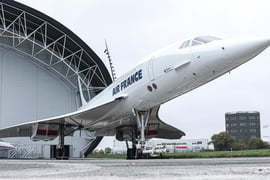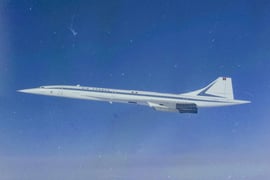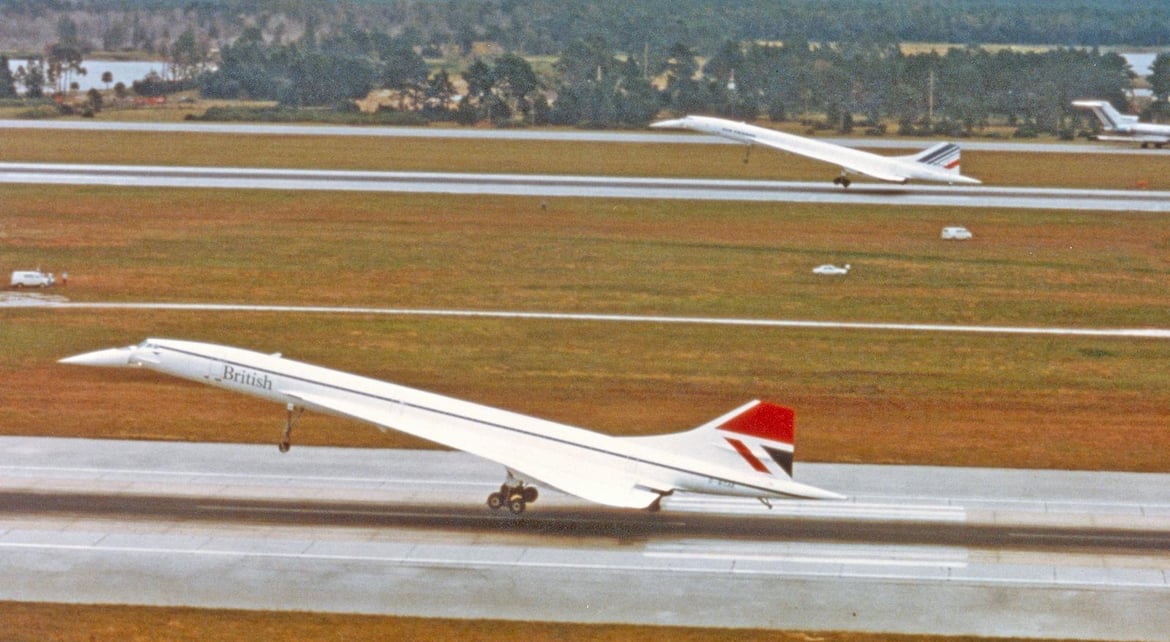
More than four decades ago, Orlando staged one of the most striking aviation publicity moments ever seen. On 18 October 1982, two Concorde supersonic airliners, one from British Airways and one from Air France, approached Orlando International Airport side by side and touched down almost simultaneously on parallel runways. The scene looked choreographed for cinema: two white, needle-nosed aircraft descending like mirrored swans, watched by more than thirty thousand spectators who crowded roads, fences, and rooftops.

The key context, often forgotten today, is that this was not simply an operational coincidence or a routine VIP charter. It was a carefully planned publicity stunt arranged by Walt Disney to mark the opening month of EPCOT Center and specifically to honor the unveiling of the United Kingdom and France pavilions in the new World Showcase.

EPCOT was built in 1982 around the idea of technology, optimism, and international cooperation. To Disney, the Concorde symbolized exactly that. It was a cross-continental engineering project between Britain and France, wrapped in sleek futurism and known worldwide as a symbol of speed and progress.

The decision to bring one British Airways Concorde and one Air France Concorde together in Orlando was a way to emphasize that EPCOT was not just a themed attraction, but a stage where nations and companies showcased their most advanced image of themselves.

The core incident itself is well documented. At the time, Orlando International Airport had recently transitioned from the former McCoy Air Force Base. The arrival was organized by Disney and the corporate sponsors of the national pavilions. The aircraft involved are identified in airport social records and enthusiast archives as British Airways G-BOAE and Air France F-BVFC.

The two aircraft approached from the south and touched down on parallel runways of approximately 12,000 feet, with a separation of roughly two seconds. That timing matters because an earlier attempt at Washington Dulles in 1976 fell short due to congested air traffic, forcing the Concordes there to land more than a minute apart. Orlando, with less congestion and more maneuvering space, is considered the only true simultaneous Concorde landing.

The spectacle drew enormous crowds. It is estimated that between 30,000 and 35,000 people watched the landing, as reported by UPI. Traffic stalled for miles. Some travelers on regular outgoing flights abandoned their itineraries because they could not reach their gates.

For Orlando International, which was still growing its identity as a major airport, this event became a statement: the city was capable of hosting a globally significant moment in aviation. It was a declaration of ambition at a time when Orlando was still crafting its place in the world beyond theme parks.

The departure of the Concordes is where myth and technical reality often become blurred. There is a widely repeated story that the Concordes “cooked the runway” and shut the airport down for a week. It is true that the Concorde’s engines and gear profile made it one of the most demanding aircraft ever to operate on asphalt. The Rolls-Royce SNECMA Olympus 593 engines were pure turbojets with afterburners, unlike the high-bypass turbofans used by most airliners.

When the afterburner was engaged during takeoff, the exhaust was extremely hot and concentrated. Because Concorde sat relatively low to the ground, with engines close to the surface, the jet blast could be directed into the pavement behind the aircraft. If the asphalt binder reached softening temperatures, which can begin in the 50 to 60 degrees Celsius range, the surface could rut or scuff. Combined with Florida heat and the high tire pressures of the Concorde’s landing gear, there is technical plausibility to the claim that sections of the surface could have been stressed or damaged.

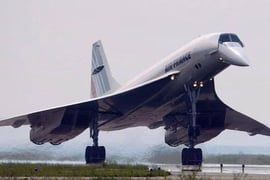
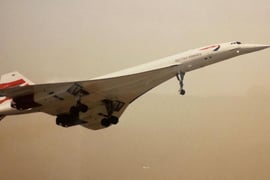
Concorde landing at New York city’s JFK airport.
However, no primary contemporary source clearly states that the runways were destroyed or that the airport closed for a week following the event. What can be safely said is that airports that handled Concorde regularly, such as Heathrow or JFK, reinforced their pavements in anticipation. Orlando did not normally host Concorde operations, so any wear, heat marks, or need for repairs would have been more noticeable. The story of runway damage persists because it fits the broader truth about Concorde: it was magnificent, it was demanding, and it pushed infrastructure to its limits.

In the end, the Orlando dual landing stands as the most photogenic and symbolically ambitious Concorde display ever staged. It was an aviation theater executed with precision timing and a promotional purpose. It fit perfectly into EPCOT’s early narrative of unity, technology, and global imagination. For a brief moment in 1982, the future did not just feel close. It touched down together, wingtip to wingtip, in front of everyone.