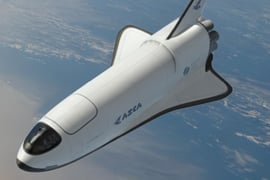
It has been twenty-two years since Concorde took its final flight, bringing an end to the world’s only sustained experiment in supersonic civil aviation. Since then, air travel has been locked at subsonic speeds, with no successor able to match Concorde’s blend of speed and engineering daring. Now, Britain and Europe see a chance to return to the frontier. The Invictus project, announced under the European Space Agency and led by UK-based consultancy Frazer-Nash, aims to deliver something even more audacious: a reusable hypersonic “space plane” that could travel from London to New York in just one hour.

Where Concorde pushed to Mach 2.04, Invictus is designed to cruise at Mach 5, which is five times the speed of sound, or more than 3,800 miles per hour. At that velocity, the aircraft would slash transatlantic travel times and create the foundation for vehicles that can operate as both ultra-fast airliners and orbital launchers. The target is ambitious: a first flight by 2031, and a concept demonstrator in just twelve months.

The backbone of Invictus is the SABRE engine, or Synergetic Air-Breathing Rocket Engine, as reported by Space.com. Originally developed by the now-defunct Reaction Engines, SABRE was conceived as a dual-mode propulsion system that operates as a jet in the atmosphere before transitioning to rocket thrust beyond it. Its genius lies in a single piece of technology: the precooler.

Air entering the engine at hypersonic speeds exceeds 1,000 degrees Celsius, far too hot for compressors and turbines to handle. The SABRE precooler uses an ultra-fine heat exchanger loop filled with helium to chill that air in milliseconds, dropping its temperature to manageable levels before combustion. This means SABRE can “breathe” atmospheric oxygen up to Mach 5 without needing to carry heavy oxidizer tanks, making aircraft lighter, more efficient, and capable of runway operations.

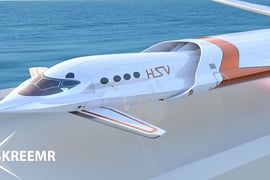
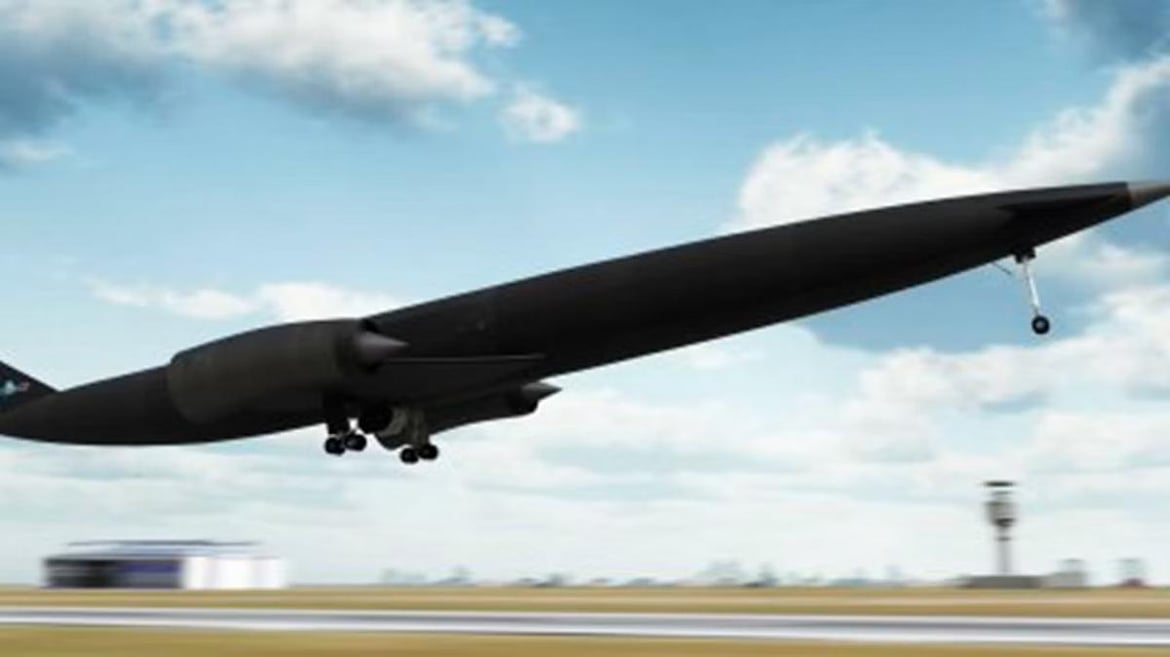
Though Invictus is still only a funded study, its likely design language can be drawn from an earlier Reaction Engines concept: the LAPCAT A2. That project imagined a 139-meter-long, 400-ton hydrogen-fueled airliner carrying 300 passengers at Mach 5.2. To cope with the stresses of hypersonic flight, its fuselage would use advanced ceramic panels instead of aluminum or titanium, which would melt under skin temperatures approaching 1,000 degrees Celsius.

The LAPCAT A2 also dispensed with windows, replacing them with interior display screens linked to external cameras, both to reduce weight and to maintain structural integrity. Powered by four Scimitar precooler-based engines derived from SABRE, the A2 promised an antipodal range of 18,700 kilometers, making it capable of connecting Europe with Australia or Asia in a matter of hours.

Invictus is, by comparison, modestly funded with just £7 million (close to $10 million) in seed money. Yet ESA views it as a technological pathfinder. If it can validate SABRE’s precooler integration, demonstrate thermal resilience at Mach 5, and prove runway reusability, the project could become the cornerstone of Europe’s hypersonic ambitions. Beyond civil travel, the implications are strategic: hypersonic vehicles are of intense interest to militaries and could redefine access to orbit.

In many ways, Invictus is Concorde’s spiritual heir. Concorde redefined expectations of civil aviation in the 1970s, but was constrained by sonic boom restrictions, fuel costs, and limited passenger capacity. Invictus promises to leap beyond those limits, powered by hydrogen fuel and a new generation of engines that combine rocket efficiency with aircraft versatility. The road to Mach 5 will be steep, but if successful, Britain and Europe could once again lead the world into a new era of flight.