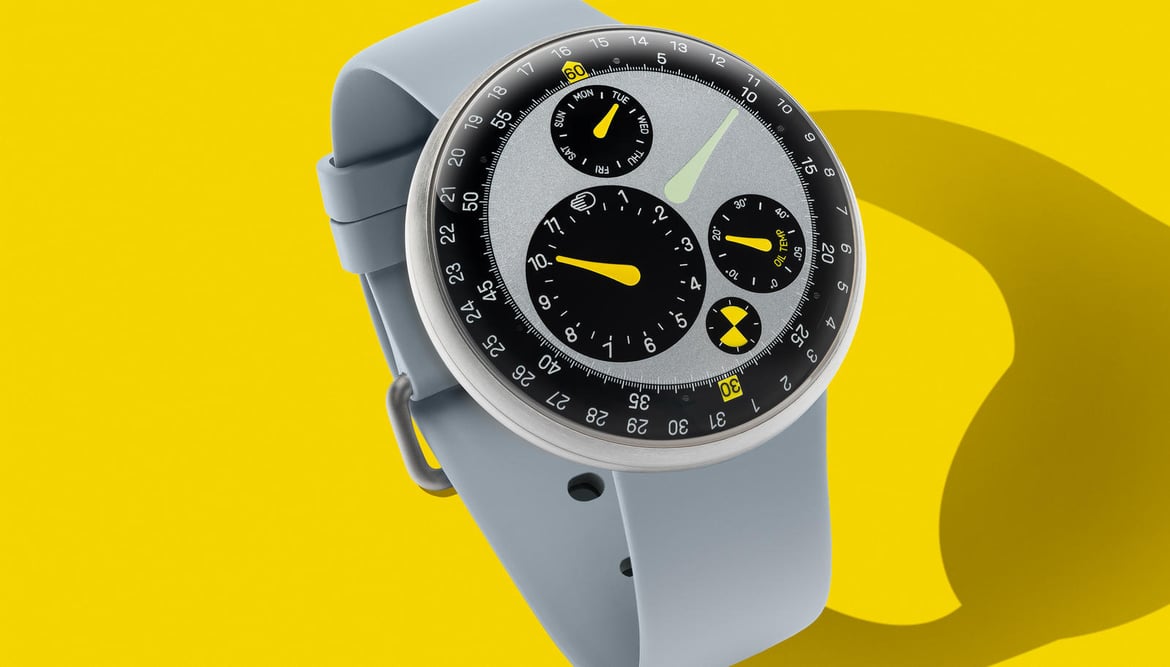
The meeting of Ressence and Marc Newson always felt inevitable, but the new TYPE 3 MN makes that convergence feel almost natural. Newson is one of the few industrial designers who can legitimately be called a global cultural figure, with a career that stretches from furniture concepts to aircraft cabins, from the Apple Watch to the enormous superyachts Solaris and the Nausicaä.

His visual language has shaped modern design in ways most people don’t even realize, and seeing that world collide with Ressence’s radical approach to displaying time creates something genuinely compelling. The question that frames this collaboration is simple but powerful: what happens when the mind behind Ikepod and the Apple Watch returns to a fully mechanical watch, but keeps all the visual and ergonomic lessons from the digital era.

The TYPE 3 MN answers that by leaning fully into Newson’s instinct for rounded, pebble-like forms. The watch has no sharp visual disruption, no harsh transitions, just a continuous flow from case to crystal and strap. It shares the same “pebble” instinct seen in both Ikepod and the Apple Watch, where the object feels smoothed by decades rather than machined by tools.

Ressence already had a reputation for designing watches that behave more like living interfaces than traditional dials, and Newson’s influence makes that quality even stronger. The controlled color palette of soft green, grey, black, and a single yellow accent reinforces that clean, logo-light aesthetic associated with Apple’s finest work. There is no heavy branding, no distraction, only information delivered with clarity.

What truly defines the TYPE 3 MN, however, is the way it presents time. Ressence describes the Type 3 as reminiscent of a digital screen because the oil-filled upper chamber eliminates refraction, making the indications look as though they float on the surface of the glass. This effect directly echoes Apple’s obsession with making content appear to live “on” the glass rather than beneath it. The interface parallels are striking. Both Apple Watch and Ressence are about making the interaction surface the primary experience. Apple achieves that with pixels and touch. Ressence accomplishes it with rotating discs, oil, and magnetic transmission. The result is the same illusion: information that seems to detach itself from hardware.

“As a longstanding admirer of Benoît’s pioneering engineering and unique approach to watchmaking at Ressence, this collaboration provided a wonderful opportunity to synthesise our approaches; to conceive of a design that was distinct and innovative, yet cohered with my design language,” said Newson.

The MN remains fundamentally different in one important way. It is purely mechanical, driven by Ressence’s ROCS module, with a 36-hour power reserve and no electronics of any kind. There are no notifications or connectivity features. It performs a single function, telling time, but in a way that challenges nearly every convention of mechanical watchmaking.

The dial uses Grade 5 titanium discs, biaxial satellites, and engraved Super-LumiNova to deliver hours, minutes, running seconds, day, date, and oil temperature, all reorganized into an orbital system that behaves like an analogue interface.

The watch measures 45 mm by 15 mm, weighs 95 grams including strap and buckle, and is built from Grade 5 titanium with a double-domed sapphire crystal. Limited to 80 pieces, the TYPE 3 MN is priced at CHF 46,000 (roughly $57,000) before taxes and available through the brand’s online store and select retailers. It feels less like a commemorative collaboration and more like a design conversation brought to life, where two philosophies meet and create something that neither could have produced alone.