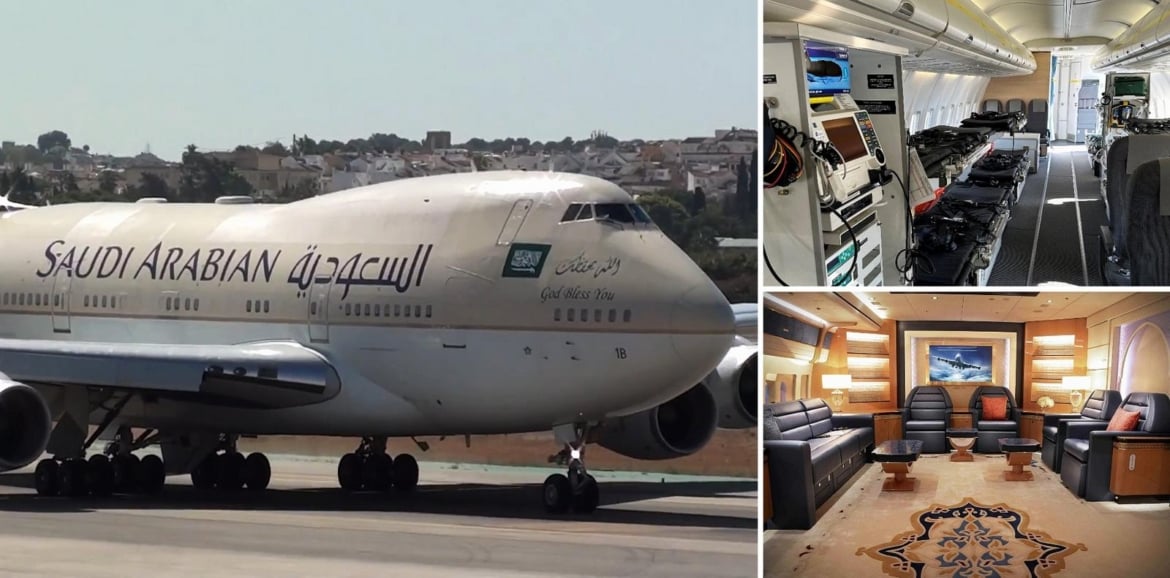
Following cataract surgery in Geneva, King Fahd, who was the ruler and Prime Minister of Saudi Arabia from 1982 till 2005, traveled to Spain in a manner that reflected both routine royal luxury and an added layer of medical necessity. While the use of a private Boeing 747 was standard for a monarch of his stature, what set this journey apart was the presence of a Boeing 757 that had been converted into a flying hospital, deployed specifically to support his fragile health during the long transfer from Switzerland to the Costa del Sol. The pairing of the two aircraft turned an otherwise familiar royal movement into a carefully managed medical operation conducted at altitude.

What unfolded over Málaga reinforced that this was never about a single aircraft. Contemporary Spanish coverage described a broader formation of Saudi planes that effectively created an air bridge between Geneva, Saudi Arabia, and southern Spain. The king’s 747, which landed in the early evening, was only the most visible element of that movement.

Reporting from El País suggested that as many as seven aircraft were involved, some tasked with transporting food supplies, luggage, and armored luxury vehicles. The presence of the converted 757 at the front of that formation positioned the operation as something far more deliberate than a standard royal transfer.

A flying court built around fragility
The scale of the logistics becomes more coherent when viewed against the king’s medical condition. Spanish reports repeatedly emphasized his fragility following surgery, and the choreography on arrival reflected that reality at every stage. A lift-style vehicle was deployed to remove him from the jumbo jet without the use of stairs, while a specially equipped armored Mercedes with a hydraulic seat stood ready on the tarmac to facilitate a seamless transfer. The convoy that followed reportedly included vehicles configured for intensive medical support or communications, extending the controlled environment from air to ground.

BlueStar167
This approach was mirrored in the air. The inclusion of the converted 757 reframed the journey as one centered on continuity of care rather than simple transport. It was not an auxiliary aircraft but a critical support platform, ensuring that advanced medical supervision remained immediately available throughout the flight. In effect, the king was traveling within an environment where aviation and clinical infrastructure overlapped, allowing long-distance movement without compromising stability.

The 757 that became a lifeline in the sky
A standard Boeing 757 is typically designed to carry around 300 passengers, but in this case the interior would have been entirely reconfigured to prioritize medical capability over capacity. The aircraft was most likely adapted into a long-range critical care transport platform, built to sustain and monitor a high-risk patient across extended sectors.
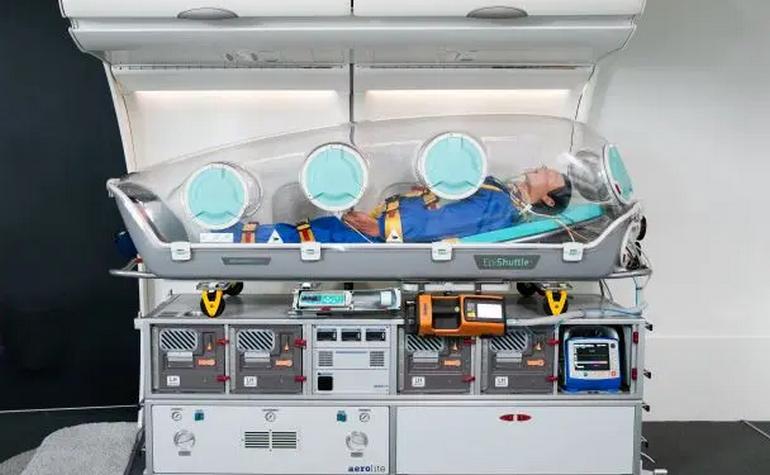
Such a configuration would typically include stretcher or bed stations secured for flight conditions, along with dedicated oxygen systems and reinforced electrical infrastructure capable of powering sensitive medical equipment. Storage for drugs and supplies would have been integrated into the cabin, enabling medical teams to operate with the readiness of an intensive care unit. Equipment such as transport ventilators, cardiac monitors, intravenous pumps, and defibrillation systems would form the backbone of the setup, supported by airway management tools, suction systems, and emergency medications.

What remains uncertain is whether the aircraft included full surgical capability. There is no widely verified evidence confirming the presence of an operating theater or anesthesia suite on this specific jet. In aviation terms, the label “flying hospital” often refers to advanced critical care transport rather than a literal airborne surgical environment, and that interpretation aligns most closely with the available information.

By the time he reached Spain on August 14, 2002, the scale of the operation had already underscored how medical necessity and royal protocol could merge into a single, highly coordinated system. During his stays, he frequently resided at the Mar-Mar Palace within his Nahda complex, a sprawling estate built in the 1980s that served as his summer base on the Costa del Sol. The arrival in Málaga was therefore not just a relocation, but a demonstration of how far aviation could be adapted to carry not only a monarch, but the infrastructure required to keep him alive and stable in transit.