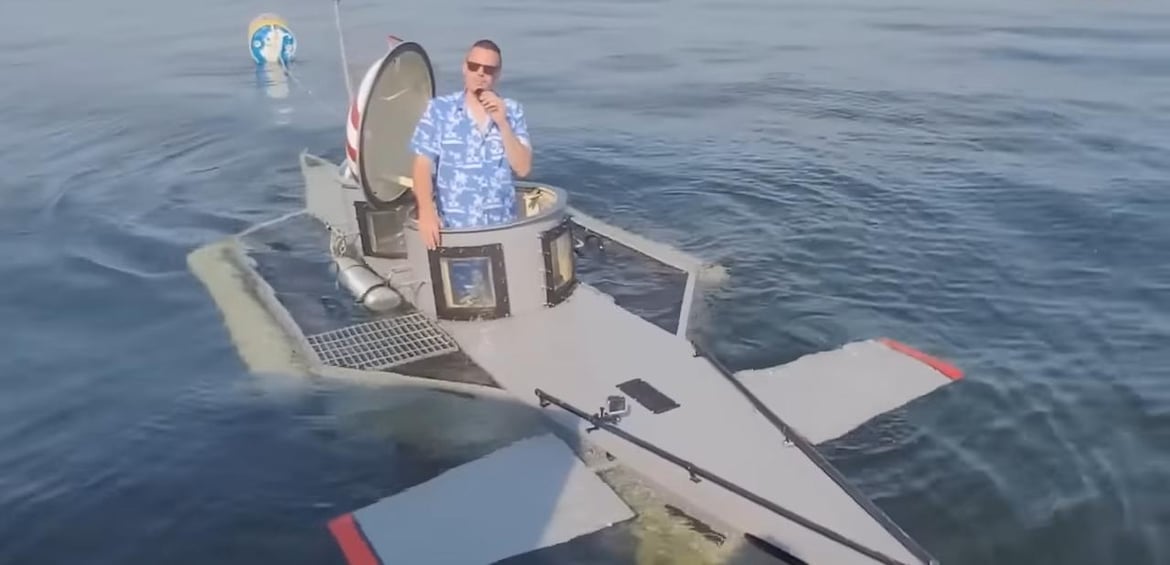
Meet Steve, a 31-year-old professional boat builder who took hobby engineering from amateur level to expert territory with grit, grind, and a surprising amount of gumption. It took 4,000 hours and plenty of sweat, and tears, including a six-month sabbatical out of sheer frustration for welding steel incorrectly; a mistake that cost him $2000. The result is now on full display on his YouTube channel, a 26-foot, 6,000-pound steel freshwater submarine called Lake Defender. No small feat, the vessel was built entirely by him and supported by guidance from the small but dedicated P-Subs (Personal Submersibles) community.
Steve lives close enough to his test lake to be on the water in about 20 minutes, a convenience that became essential during the long trial process. Lake Defender famously drew the attention of local police, scared a woman who thought it was an enemy invasion, and earned Steve the nickname “the submarine guy,” with the cops. The machine is impressive, but the process is the real hero here; it is a story of persistence and obsession more than anything else. And before Steve unveils his next wave of “toys,” as he calls them, like DIY water cannons and rocket launchers, here is a deep dive into his personal submarine.

Steve has no formal training in submarine construction. The boat builder spent hundreds of hours researching and relying on the P-Subs community, their designers, engineers, and seasoned hobbyists to review his ideas and stress-test his plans.

With the basic sub structure ready, Steve faced the hardest part, welding it to perfection to ensure safety at depths of up to 60 feet underwater. He intentionally capped his operational depth far above the estimated crush depth of roughly 120 feet for a safer margin.

Steve built a 1/10th-scale test model to check weight distribution and stability. The miniature version revealed where material needed to be removed and how ballast tanks should be repositioned. He shifted the ballast tanks in the full-size version for greater stability and neutral buoyancy beneath the surface.

The submarine is controlled by a compact lap-mounted apparatus built around a joystick. It operates everything, including the three electric motors inside this Coast Guard–registered submarine.

A CO₂ meter helps Steve monitor air quality. With oxygen supplies and soda-lime scrubbing, he can safely remain submerged for up to eight hours.

The first water trial took place after four years, 4,000 hours of labor, and $26,000 in materials, plus countless hours of planning, welding, and redesigning.

The interiors of the submarine come alive during the second successful trial. Lake Defender is a fully functional electric freshwater submarine designed for lakes only, with a planned operating depth of 60 feet and a crush-depth estimate nearly double that.