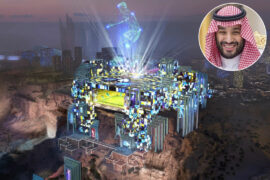
When Saudi Arabia unveiled Trojena in 2022, Crown Prince Mohammed bin Salman described it as a place that would “redefine mountain tourism … based on ecotourism principles.” His words matched the boldness of the plan. A futuristic ski resort in the desert, crowned by a man-made lake stretching 2.8 kilometers along a mountain ridge, would serve as the showpiece of Neom and host the Asian Winter Games in 2029. On paper, it sounded dazzling. In reality, it has become one of the most complicated engineering headaches in the entire $1.5 trillion megacity.

The mountain lake that shouldn’t exist
The centerpiece of Trojena is this colossal lake, which industry reports say will cover 1.5 square kilometers and be held back by three dams. The largest of them is expected to rise 145 meters high and extend 475 meters in length. Italian builder Webuild has already secured a $4.7 billion contract to make it happen, a price tag that underlines how ambitious the project really is.

The lake is meant to be more than a pretty backdrop. It will anchor ski slopes, hotels, and public promenades, and provide water for the resort’s artificial snow systems. But filling it is another matter altogether.

Unlike alpine regions, Trojena has no glaciers or rivers to rely on. Instead, engineers plan to pipe in desalinated seawater from the Red Sea. The pipeline, about one meter in diameter, will climb nearly 2,400 meters from the coast to the mountain plateau. The sheer energy required to push that much water uphill is staggering, and it is this part of the plan that has started to worry insiders.

Racing against the Winter Games
In October 2022, the Olympic Council of Asia voted unanimously to award Saudi Arabia the right to host the 10th Asian Winter Games at Trojena. It was a historic decision, marking the first time the Games would be held in West Asia. The program will feature 47 events across snow and ice, two competition clusters, and an athletes’ village. Saudi Sports Minister Prince Abdulaziz bin Turki Al-Faisal hailed the announcement as “a great victory for the Saudi nation and the people of the Gulf.”

Delivering on that promise, however, is proving to be a race against time. Hosting the Winter Games requires infrastructure to be ready years in advance, not months before kickoff. Yet construction is still in its early phases, with satellite images showing tunneling works and slope preparations, but little evidence that the massive lake is anywhere near completion. Analysts point out that if deadlines slip, the kingdom may be forced to scale back certain elements just to ensure the Games go ahead.

Ambition meets harsh reality
Trojena is only one piece of Neom, which has ballooned into a $1.5 trillion megacity project with other regions such as Sindalah Island and The Line facing delays or redesigns. The financial strain is growing as oil prices hover at levels far below what Riyadh needs to balance its budget. Bloomberg estimates the kingdom requires crude at $94 a barrel to cover government spending, and as high as $111 if Neom’s Public Investment Fund projects are included. Current prices are closer to $66.

Still, backing away is not an option. The Asian Winter Games, followed by the 2027 Asian Cup, the 2030 World Expo, and the 2034 FIFA World Cup, are international commitments that Saudi Arabia has staked its global reputation on. Crown Prince Mohammed bin Salman is under pressure to prove that these grand projects can be delivered, even if the process is messy.

For now, construction presses on, and engineers are wrestling with the extraordinary challenge of pumping desalinated water up to a lake that should not exist in a desert. Whether Trojena’s glittering lake becomes a functioning centerpiece or a costly symbol of overreach will depend on how much time, money, and determination the kingdom can throw at it before 2029 arrives.