London had barely finished absorbing the optics of a Saudi-registered Rolls-Royce being towed from Grosvenor Square when the same stretch of pavement delivered a sequel no one expected. At the exact spot where Westminster City Council had quietly removed an illegally parked luxury coupe, a Saudi billionaire rolled in and parked a multi-million-pound convoy of hypercars. Same location. Same backdrop. Very different outcome.

This time, there was no tow truck, no quiet relocation, and no confrontation. Instead, a perfectly arranged lineup appeared, calm and deliberate, with official parking permits clearly visible on the windscreens. Every vehicle was legally parked. No pavement blocking. No technical violations. Just wealth, precision, and paperwork doing the talking.

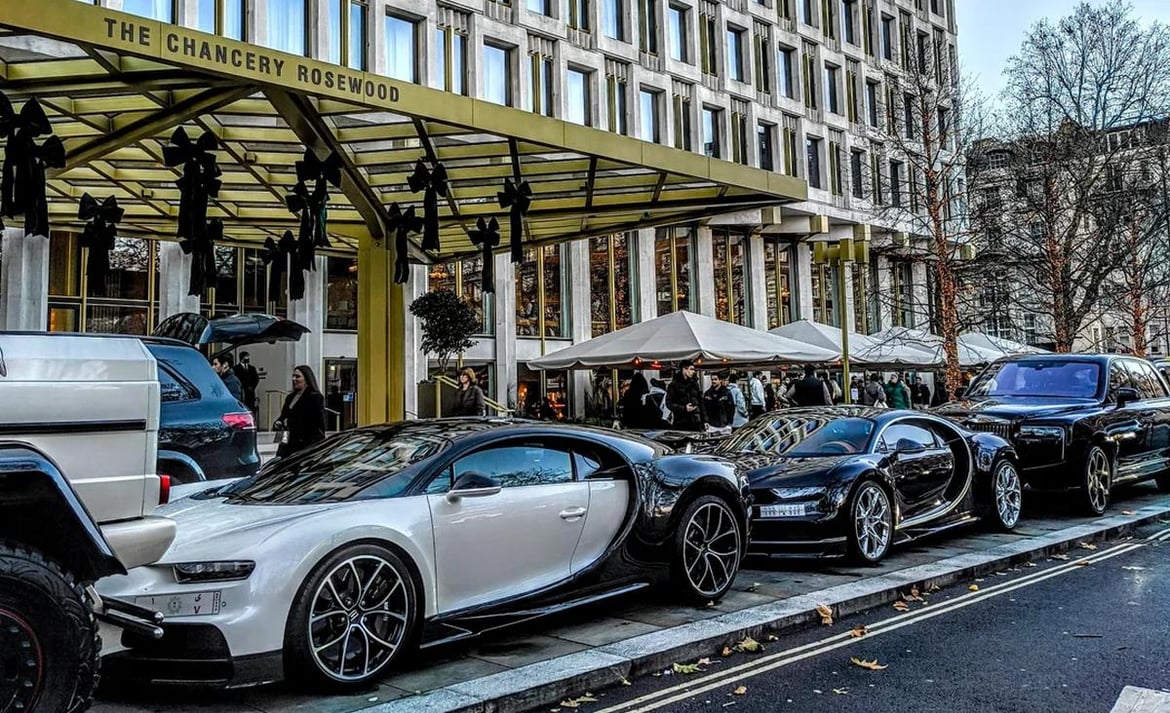
The convoy belonged to Yazeed Al-Rajhi, a name that resonates across both motorsport and Middle Eastern finance. Front and center were two Bugatti Chirons, one finished in black and the other in white with dark accents, parked nose to tail like a private showing that somehow spilled onto a London street. Behind the black Chiron sat a black Rolls-Royce Cullinan, closing the formation at the rear. At the front, partially visible but unmistakable, was a Mercedes-AMG G 63 6×6, the six-wheeled brute that has become a cult object among Gulf collectors.

The black Chiron drew instant attention thanks to its Saudi registration plate: “111111 DUE.” Six identical digits, no subtlety required. Through the glass, a red interior was visible, a reminder that this was not a static prop but a functioning hypercar. The white Chiron ahead of it completed the visual punch. While it is not possible to pin down exact sub-variants from the images alone, both cars are clearly standard Chiron silhouettes, and that alone sets a financial baseline few streets on Earth ever host.

Each Bugatti Chiron is worth more than $2.5 million, and in the UK market today, values often hover around £2.7 million depending on spec and history. Two together comfortably clear £5 million (about $6.75 million) before a single wheel of the supporting cast is counted. The Mercedes-AMG G 63 6×6, produced in tiny numbers and deeply associated with Gulf wealth culture, frequently trades well above half a million pounds. The Cullinan, even in relatively restrained form, sits around £300,000 (roughly $4 million), with bespoke commissions pushing far beyond that.

Taken together, the “billionaire sandwich” can be conservatively framed in the $8 million to $11 million-plus range without stretching the math or leaning on fantasy valuations. And that figure does not include the detail that arguably says the most. The “1V” number plate alone reportedly cost around $2.6 million, acquired by Al-Rajhi at auction in January 2024. The plate bolted to the Chiron’s nose is, by itself, worth more than the Rolls-Royce Westminster towed days earlier.

Al-Rajhi’s profile explains the ease with which such moments unfold. He is a rally champion with multiple major titles to his name, a serious competitor rather than a weekend enthusiast. Off the stage, he is a business magnate and the son of the founder of Al Rajhi Bank, the largest bank in the Middle East. His wealth is institutional, inherited, expanded, and deployed with confidence.

That context matters. Where the earlier towed Rolls-Royce symbolized frustration with rule-breaking wealth, this convoy sent a cleaner, sharper message. The cars were not daring authorities to act. They were complying perfectly, permits displayed, lines respected, and rules followed to the letter.

For Londoners, the contrast was striking. For spotters, it was an automotive spectacle. And for the city itself, it underlined the uncomfortable reality at the heart of its supercar season. Enforcement works, but only when the rules are clear. When they are followed, even a street worth eight figures becomes just another legally parked row of cars, waiting quietly for London to decide what it wants to be next.